Ως πρόβα επίθεσης μεταφράζουν οι ειδικοί τους επικίνδυνους ελιγμούς που έκανε ρωσικός στρατιωτικός δορυφόρος σε απόσταση αναπνοής από δυτικό εμπορικό δορυφόρο τον περασμένο μήνα, προκαλώντας φόβους για μεταφορά των γεωπολιτικών συγκρούσεων στο διάστημα, σε ένα σενάριο που θυμίζει... Star Wars.
Την ίδια ώρα, δύο σκάφη που σχετίζονται με τη Ρωσία κατευθύνονται τώρα προς έναν άλλο δυτικό δορυφόρο, γεγονός που εντείνει την ανησυχία.
Μετά το περιστατικό του Οκτωβρίου, ο υφυπουργός Εξωτερικών των ΗΠΑ, Τόμας ΝτιΝάνο, ανέφερε στο X ότι ο ρωσικός στρατιωτικός δορυφόρος Cosmos 2612 «ελισσόταν σκόπιμα επικίνδυνα κοντά σε έναν εμπορικό δορυφόρο» σε ενέργειες «που συνάδουν με επιχειρήσεις διαστημικών όπλων».
As just announced in the @UN First Committee, Russia’s COSMOS 2612 military satellite has been exhibiting threatening behavior by intentionally maneuvering dangerously close to a commercial satellite, behaviors consistent with on-orbit weapons operations. This violates long-established safety thresholds in low Earth orbit. The United States will continue to secure and defend American vital national security interests in, from, and to space.
— Under Secretary of State Thomas G. DiNanno (@UnderSecT) October 21, 2026
Ο δορυφόρος που βρέθηκε στο στόχαστρο, είναι ο X36, λειτουργεί από τη φινλανδική εταιρεία ICEYE και παρέχει εικόνες ραντάρ σε δυτικές κυβερνήσεις και στρατούς, συμπεριλαμβανομένης της Ουκρανίας. Τρεις ειδικοί του διαστήματος χαρακτήρισαν το περιστατικό ως μία από τις στενότερες γνωστές προσεγγίσεις ρωσικού στρατιωτικού διαστημικού σκάφους σε εμπορικό δορυφόρο σε τροχιά χαμηλού ύψους.
Η συνάντηση «μοιάζει με πρόβα επίθεσης», δήλωσε στο Reuters ο Γκρεγκ Γκίλινγκερ, ανώτερος αναλυτής διαστήματος στην Integrity ISR, μια αμερικανική εταιρεία που παρέχει εκπαίδευση στις διαστημικές δυνάμεις των ΗΠΑ. «Αυτή είναι η πιο επιθετική στάση που έχω δει να κρατά η Ρωσία όσον αφορά την απειλή δορυφόρων άλλου έθνους» είπε χαρακτηριστικά.
Διαβάστε Επίσης

Η Μόσχα έχει προειδοποιήσει επανειλημμένα ότι οι εμπορικοί δυτικοί δορυφόροι που βοηθούν την Ουκρανία θα μπορούσαν να γίνουν νόμιμοι στόχοι για αντίποινα.
Στο κόκκινο η ένταση (και) στο διάστημα
Το επεισόδιο του Οκτωβρίου έχει προκαλέσει μεγάλη ανησυχία για την ευάλωτη θέση των εμπορικών δορυφορικών δικτύων, τα οποία έχουν γίνει ολοένα και πιο σημαντικά για στρατιωτικές επιχειρήσεις. Συνέβη μετά από μήνες ρωσικής δραστηριότητας γύρω από την ICEYE, την οποία δυτικοί αξιωματούχοι έχουν προειδοποιήσει ότι αποδεικνύει δυνατότητες που θα μπορούσαν να χρησιμοποιηθούν για απειλή ή διαταραχή εμπορικών αστερισμών δορυφόρων, συμπεριλαμβανομένων αυτών που διαχειρίζεται η SpaceX του Έλον Μασκ.
This is what Russia’s Cosmos 2612 approaching to about 160 metres might have looked like from on board ICEYE-X36. It’s a simulation from public data, with the relative position of both satellites, their place above the Earth, the sunlight and the whole scene around them computed.
We put the whole pass into our simulator, with orbital data from the last three weeks and our own cameras standing in for onboard ones. At the start the Russian satellite is on the far side of the Earth, several thousand kilometres away. When it comes out from behind the horizon it’s a pixel, maybe two, in every camera. With each manoeuvre it turns into a clearer shape, until it is a few hundred metres from @iceye_global and you can see every detail.
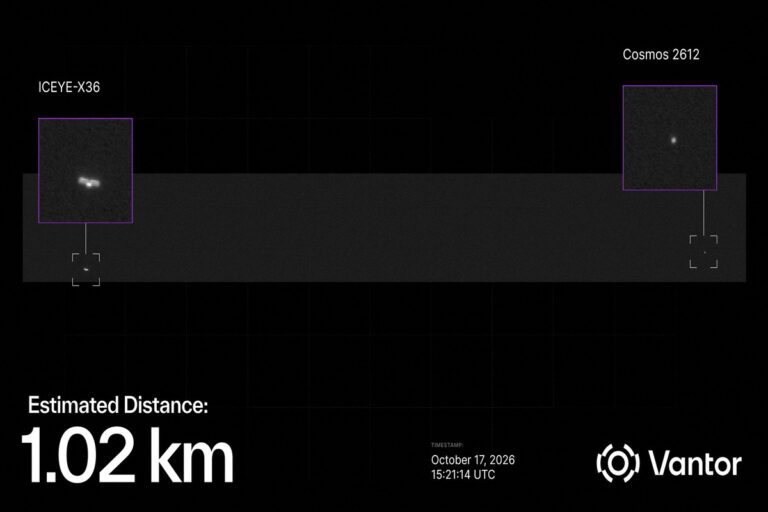
What happened, briefly. From late September Cosmos 2612 manoeuvred into the orbit of ICEYE-X36, a radar satellite from the company whose imagery Ukraine uses. For many hours it circled ICEYE on a tight ellipse, from a few kilometres down to a few hundred metres. Overnight Saturday to Sunday it made a manoeuvre, raised its orbit and started drifting away. The 26 metres figure going around today is an automated prediction computed from pre-manoeuvre data. By our calculations the closest approach was probably about 160 metres, though the accuracy of public data allows anything from tens to hundreds of metres.
Russia has done this kind of thing before, though in LEO usually at kilometres or tens of kilometres. A few hundred metres from a commercial satellite supporting one side of an ongoing war is something I struggle to find a public precedent for.
There is one more thing about that circling. Cosmos went around ICEYE once per orbit, about every 95 minutes, while the Sun went around the pair of them. So in every loop it saw ICEYE from every side and in every lighting condition, from full light to side light, where shadows bring out the geometry of the antennas. Hard to design a better setup for optical reconnaissance. Quite possibly radio reconnaissance too. From a few hundred metres you can collect the characteristics of ICEYE’s signals that would be useful for future jamming, or even test it. According to the reconstruction, the departure manoeuvre lands almost exactly on the moment ICEYE came out of Earth’s shadow. I just don’t believe in coincidences like that.
TBH: These reconstructions and our numbers are good to plus or minus some fifteen minutes, so we can’t be certain.The manoeuvre was reconstructed from public data by @AdamCohen8, an engineer in the @USSpaceForce, in his own private analysis. We get the same picture: right after the manoeuvre, around 01:38 UTC over Greenland, Cosmos was about 160 metres above ICEYE.
The cameras in the video are the wide-angle @Scanway_SA SCS, from the family that filmed Ariane 6’s first flight, and SOP telescopes, from the smallest 3U/50, on orbit since 2023, through SOP120 from the family flying in the PIAST military constellation and on lunar missions, to SOP200 and SOP450. The biggest difference between them shows at a dozen kilometres or so, where SOP450 already resolves the satellite’s shape and the smallest camera still sees a few pixels. From a few hundred metres each of them sees detail. This is research-only analysis, based solely on public data and not coordinated with ICEYE. There are no Scanway cameras on ICEYE-X36.
A few numbers from this simulation, for those who like that sort of thing:
– for this scenario the simulator loaded about 380,000 stars from the part of the sky the cameras were pointing at; almost 58,000 fell within their fields of view, and 546 are bright enough to show up in the frame at the real exposure time
– for everyday work it can draw on a catalogue of hundreds of millions of stars
– the motion of both satellites comes from 159 sets of public orbital data spanning 24 days, with 6 clear Cosmos manoeuvres in the data
– the video has 1,371 frames, with almost 4,000 renders behind them
– the simulator holds over 35,000 objects in orbit, about 22,000 of them with known shape and sizeI think this is only the beginning. Commercial satellites work more and more for the military, which makes them targets. For now mostly for someone who flies up, takes a look and makes it clear they could do more. There will be more provocations like this in orbit, and operators, civilian ones too, will want to know what is happening next to their satellites and see it with their own eyes.
Looking at it from the other side: if Polish and NATO satellites carried inspection cameras, every approach like this would become intelligence for us. Instead of guessing from orbital data what is flying next to us and what it is for, we would have close-up images of the visitor, and maybe traces of what it is trying to jam. At @Scanway_SA this is part of our day job. In early October we signed a contract with a European company for a series of 14 telescopes for on-orbit security applications, and a month ago, together with Revolv Space, we launched KIMBALL, an inspection camera on a 360° pointing mechanism with narrow and wide-angle optics in one unit. It can follow a target regardless of how the whole satellite is oriented, and on an approach from a few hundred metres, with the target sliding across the sky, that makes a huge difference.
I have so many questions for @rmodrzewski about how ICEYE handled this operationally. I won’t ask them, since most of the answers are probably classified.
What we don’t know:
– positions from public data are accurate to hundreds of metres, and the manoeuvre itself is known only from reconstruction
– ICEYE confirmed it moved its satellite; the data shows a small manoeuvre on the morning of 18 October,
– there are no images of Cosmos 2612; the radar catalogue only tells us it’s a metre-class object, so its look in the video is a hypothesis based on what an inspection mission would need
– its purpose is a hypothesis too, optical and radio reconnaissance alikeThe video is a simulation and is marked as one in every frame.
— Jędrzej Kowalewski (@jj_kowalewski) October 19, 2026
Ο Γκίλινγκερ, πρώην αξιωματικός πληροφοριών της Πολεμικής Αεροπορίας των ΗΠΑ που παρακολουθεί τους ρωσικούς δορυφόρους, δήλωσε ότι ο Cosmos 2612 φάνηκε να δοκιμάζει την ικανότητά του να επιτεθεί, διότι μια τόσο στενή προσέγγιση δεν θα χρειαζόταν για τη συλλογή πληροφοριών ή την ηλεκτρονική παρεμβολή.
Ο Cosmos 2612 κατηγοριοποιείται δημόσια ως δορυφόρος επιθεώρησης συντήρησης, σύμφωνα με την αμερικανική εταιρεία διαστημικών πληροφοριών Slingshot Aerospace. Είναι ένας από τους έξι στρατιωτικούς δορυφόρους που εκτόξευσε η Ρωσία τον Απρίλιο. Τον Μάιο, η Ρωσία τοποθέτησε τέσσερις από αυτούς κοντά στον X36. Στη συνέχεια, η ICEYE μετακίνησε τον δορυφόρο της, προκαλώντας περαιτέρω ρωσικούς ελιγμούς.
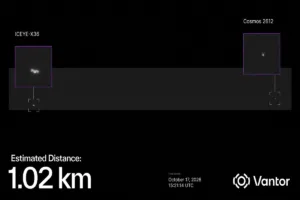
Στις αρχές Οκτωβρίου, ο Cosmos 2612 τοποθετήθηκε εκατοντάδες χιλιόμετρα πίσω από τον X36. Στη συνέχεια, μείωσε γρήγορα την απόσταση μέσα σε λίγες ημέρες, φτάνοντας σε απόσταση ενός χιλιομέτρου από τον X36 στα μέσα Οκτωβρίου, με ορισμένους αναλυτές να λένε ότι βρισκόταν σε απόσταση λίγων εκατοντάδων μέτρων ή λιγότερο.
Could there be another ICEYE RPO?
On 17 Oct COSMOS 2612 passed 59 m from ICEYE-X36. Two of its launch mates, COSMOS 2611 and COSMOS 2613, now sit in a similar setup with ICEYE-X37, which launched with X36 on 4 Mar 2024.
On distance alone there is little to see. COSMOS 2611 is about 11,800 km from ICEYE-X37 and COSMOS 2613 about 13,500 km, both well around the orbit from it. The orbits are where it gets interesting.
Our predictive rendezvous job has tracked 2611 against X37. Their planes are now 0.035° apart and still closing, reaching 0.021° on 10 Nov. Matching orbits takes 0.5 m/s to adjust altitude and 2.6 m/s to tilt the plane.
The same job flagged COSMOS 2613 against X37 on 2 Nov. Their planes come closest early on 5 Nov UTC, 0.051° apart. Matching orbits takes 1.7 m/s to adjust altitude and 6.7 m/s to tilt the plane.
Those costs assume the planes are lined up, so they apply around 5 Nov for 2613 and from 10 Nov on for 2611. In perspective, COSMOS 2612 spent a little over 30 m/s on its recent approach to X36, between 12 and 20 Oct.
#Space
— COMSPOC_OPS (@COMSPOC_OPS) November 3, 2026
Στη συνέχεια ο ρωσικός δορυφόρος απομακρύνθηκε περίπου 400 χλμ. Δύο αδελφοί ρωσικοί δορυφόροι παρασύρονται τώρα προς την τροχιακή διαδρομή ενός άλλου διαστημικού σκάφους της ICEYE, του X37. Η αμερικανική εταιρεία παρακολούθησης του διαστήματος COMSPOC εκτιμά ότι τα δύο αδελφά σκάφη αποκτούσαν ολοένα και καλύτερη θέση για να πλησιάσουν τον X37. Τόσο ο X36 όσο και ο X37 είναι εγγεγραμμένοι στις ΗΠΑ, σύμφωνα με τους δημόσιους καταλόγους διαστημικών αντικειμένων.
Ο διοικητής διαστήματος της Γερμανίας, υποστράτηγος Μίχαελ Τράουτ, εκτιμά ότι οι στενές προσεγγίσεις όπως αυτή του Cosmos 2612 θα μπορούσαν να χρησιμοποιηθούν για επιθεώρηση, παρατήρηση ή παρεμβολή, ανάλογα με τις τεχνικές δυνατότητες ενός διαστημικού σκάφους.
🇷🇺🇺🇦 Russia may have rehearsed an attack on a Western satellite supporting Ukraine, according to a U.S. military space specialist.
In mid-October, Russia’s Cosmos 2612 military satellite approached within a kilometer of X36, a Finnish-operated satellite providing radar imagery to Ukraine and Western militaries.
Space specialist Greg Gillinger described the encounter as looking like an attack rehearsal, arguing that such proximity was unnecessary for surveillance or electronic interference.
Now, two other Russian military satellites are approaching the orbital path of another satellite operated by the same Finnish company, ICEYE.
Russia has previously warned that Western commercial satellites supporting Ukraine could become legitimate military targets.
With Democrats winning the U.S. midterms and potentially expanding funding for Ukraine, Moscow may see an offensive against Western satellite networks as its next strategic move.
Source: Reuters, WTVB / Writer: Mhedi
— Mario Nawfal (@MarioNawfal) November 5, 2026
«Επομένως, πρέπει να λάβουμε υπόψη ολόκληρο το φάσμα των πιθανών επιδράσεων, που κυμαίνονται από την προσωρινή διακοπή των λειτουργιών ενός δορυφόρου έως την οριστική απενεργοποίησή του», είπε.
Προειδοποίησε ότι η ικανότητα εκτέλεσης τέτοιων ελιγμών δεν αποτελεί από μόνη της απόδειξη ότι η Ρωσία προετοιμάζει ή κάνει πρόβα επίθεσης, και δήλωσε ότι ο σκοπός της δεν μπορεί να προσδιοριστεί μόνο από δημοσίως διαθέσιμα τροχιακά δεδομένα.
Οι μεγάλες δυνάμεις προετοιμάζονται για το ενδεχόμενο επέκτασης της σύγκρουσης στο διάστημα. Η Ουάσιγκτον παραδέχθηκε πρόσφατα ότι έχει αναπτύξει όπλα σε τροχιά, ενώ ο επικεφαλής της Διοίκησης Διαστήματος των ΗΠΑ δήλωσε νωρίτερα φέτος ότι η Ρωσία είχε αναπτύξει ένα διαστημικό όπλο εντός της εμβέλειας κρίσιμων δορυφόρων εθνικής ασφάλειας των ΗΠΑ.